
Rebuilt combat and progression now reward improvisation; the city around them still prefers spectacle to simulation.
The strangest thing about modern Cyberpunk 2077 is that V has become more dynamic than Night City. A netrunner can hijack cameras, stack quickhacks, scramble a vehicle and disappear before a room understands what happened. A Reflex-heavy merc can clear a balcony with a double jump, air-dash through a window and turn the same encounter into a blade fight. A heavily chromed Body build can ignore subtlety altogether. The city supporting those choices still looks almost impossibly busy, but much of that bustle remains theatrical rather than deeply systemic.
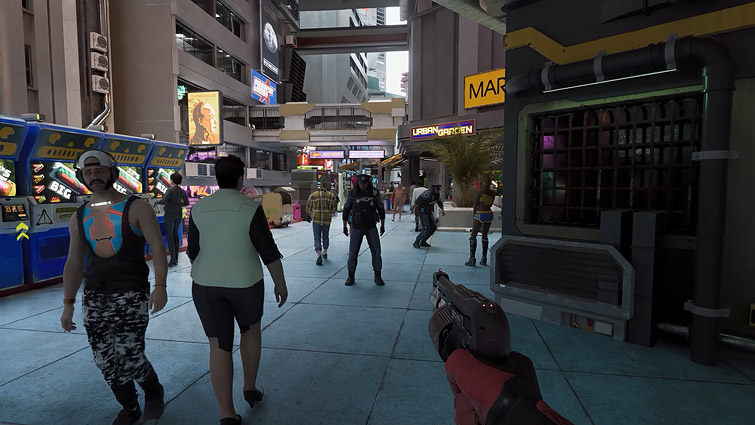
That imbalance now works in the game’s favor. CD Projekt Red’s major rebuilds shifted the center of gravity away from loot clutter and incremental stat bonuses toward abilities that genuinely alter how V moves, fights and approaches spaces. Phantom Liberty then gave those systems a denser district and some of the game’s strongest authored missions.
Cyberpunk 2077 is still not the boundless urban simulation its streets sometimes suggest. It is something more specific, and much better at being it: a first-person action RPG in which authored spaces, flexible builds and sharp character writing repeatedly outclass the open world connecting them.
The Build Is Finally More Interesting Than the Loot
The post-2.0 perk trees are the single biggest reason Cyberpunk now feels coherent as an RPG. Intelligence is no longer just a route to bigger hacking numbers; Overclock and quickhack queues reshape the rhythm of combat. Reflexes can turn dashes, blades and aerial movement into one continuous offensive loop. Body makes shotguns and blunt weapons feel deliberately aggressive, while Cool supports precision, throwing weapons and stealth instead of merely nudging percentages upward.
Cyberware gives those choices physical consequences. Armor now comes primarily from implants, and Cyberware Capacity prevents every useful piece of chrome from being equipped at once. A Sandevistan build solves encounters through time and positioning; a cyberdeck build treats cameras, enemies and vehicles as nodes in the same network. Even movement implants matter beyond traversal. Double-jump legs and aerial-control perks can turn a balcony, roofline or service entrance into part of a stealth route that a ground-bound build would never consider.
The freedom is not absolute. Perks can be refunded freely outside combat, but Attribute points receive only one full reset, so a late decision to transform a committed netrunner into a radically different archetype still carries friction. The economy develops a similar reversal. Once money stops being scarce, players intent on pushing many Iconic weapons toward Tier 5++ can find crafting components more valuable than another pile of eddies, making dismantling high-tier loot more sensible than selling everything. Those constraints are not fatal, but they expose how much better the game is at encouraging experimentation within a build than between completely different builds on the same save.
The Best Missions Treat Buildings Like Problems, Not Corridors
Cyberpunk’s strongest encounter spaces rarely announce a correct route. A fixer gig might put a target inside a warehouse, apartment block or club, then let the architecture do the explaining: cameras can be hijacked, side doors opened, guards distracted, upper floors reached from outside, or the entire problem reduced to gunfire. It never becomes a full immersive sim, yet the best missions understand the appeal of letting a player discover an approach rather than selecting one from a menu.
The same philosophy helps the story. The Relic crisis gives V a reason to keep moving, but the memorable material is usually smaller and more personal: Judy trying to salvage something decent from Night City’s exploitation, Panam negotiating loyalty to the Aldecaldos, or Johnny Silverhand shifting between antagonist, parasite and uncomfortable confidant. Lifepaths add useful texture without becoming three separate campaigns. Corpo, Streetkid and Nomad dialogue can occasionally reveal leverage or a different reading of a situation, but just as often they function as characterization rather than meaningful advantage. That unevenness is disappointing only if the opening choice is expected to restructure the whole game.
Harder Fights Show How Much the Combat Has Improved
At its best, combat is a chain of small decisions made quickly. A camera can reveal a sniper before the room opens up. A hostile netrunner can become the priority because a debuff at the wrong moment is more dangerous than another rifleman. An enemy with Sandevistan can answer V’s own time-slowing tricks instead of standing helplessly inside them. On higher difficulties, those roles matter more because bad positioning and ignored specialists are punished before raw damage output can solve everything.
That does not make every firefight brilliant. A mature build can still overwhelm ordinary groups so efficiently that enemy behavior becomes secondary to execution. Once the strongest perk and cyberware synergies are online, the pleasure often lies in running the machine cleanly: queueing hacks in the right order, maintaining movement, chaining finishers or collapsing distance before ranged enemies can stabilize. MaxTac, cyberpsychos and stronger bosses create more resistance, but Cyberpunk remains more impressive as a sandbox of offensive tools than as a game of consistently brilliant opposition.
Dogtown Gives Exploration a Better Pulse
Phantom Liberty works partly because Dogtown compresses Cyberpunk’s strengths. The district is smaller, rougher and more vertical than much of Night City, with collapsed structures, improvised markets and fortified spaces that make movement feel less like crossing a backdrop. Its spy-thriller plot also gives Solomon Reed and Songbird room to pull V between competing loyalties without turning the expansion into a detached postscript.
The recurring airdrops are a small but revealing improvement. They announce themselves with aircraft noise and red smoke rather than feeling like another icon waiting to be vacuumed off the map. Spotting one can become a short scramble across rooftops or broken infrastructure before a fight over the crate begins. Because the event is discovered through the environment, it briefly makes Dogtown feel less like a checklist and more like a place where something is happening without permission.
Phantom Liberty’s more authored sequences are stronger still. The Black Sapphire infiltration, with its social maneuvering and tense roulette-table exchange, works because the game is comfortable narrowing the space and controlling the pressure. Dogtown does not reinvent Cyberpunk’s open world. It simply proves that the game’s systems become more convincing when the environment around them is denser, more deliberate and less interested in pretending to be infinite.
Night City Still Performs Better Than It Reacts
The gap between spectacle and simulation is easiest to see outside missions. Night City remains an extraordinary piece of visual direction: Watson stacks concrete and advertising vertically, City Center turns corporate power into architecture, Pacifica looks like development abandoned halfway through a promise, and the Badlands let the skyline recede into something almost serene. Radio, signage, gang identity and fashion make neighborhoods readable before dialogue explains them.
Post-launch additions have made moving through that world far richer. The police system now escalates through Heat levels into roadblocks and MaxTac, vehicle combat allows shooting and hacking during chases, the NCART metro and portable radio add texture, races can be replayed, and AutoDrive or a Delamain cab can turn a trip across town into sightseeing. These are worthwhile additions because they reduce the dead air between missions.
They do not fundamentally change what the city is. Most civilians are still scenery with routines shallow enough to collapse under scrutiny. Many storefronts are decorative. The world rarely invites the sort of unscripted snooping, trespassing and systemic cause-and-effect that its density visually promises. Cyberpunk is at its weakest when the city itself is expected to generate drama; it is far stronger when a designer has already decided where the pressure points are.
PC Is Still Where Night City Looks Most Excessive
The PC version remains a technical showcase, especially at the expensive end. Ray Tracing: Overdrive uses path tracing to transform indirect light, reflections and the way neon spills across wet streets and interiors, while DLSS Ray Reconstruction, frame generation and newer FSR or XeSS options help make those features practical on hardware that can support them. SSD storage is now an official requirement, which makes sense for a world constantly streaming dense geometry, traffic and crowds.
That visual ceiling is impressive precisely because the art direction survives below it. Cyberpunk does not need path tracing to communicate scale, color or grime; the advanced rendering simply gives an already distinctive city more convincing light. The trade-off is familiar: the highest settings can make upscaling and frame generation part of the performance budget rather than optional extras. This is a game that can still make powerful hardware feel less powerful than expected.
Similar Posts From Us You Might Find Interesting:
– PS3 emulator for iPhone & Android
– Super Mario Bros U Deluxe for Nintendo Switch
A Great RPG, Not the Urban Simulation It Resembles
Cyberpunk 2077 finally works because its strongest systems no longer depend on the fantasy that Night City can react to everything. The rebuilt perks, cyberware and combat give V a genuine mechanical identity, while strong quests provide spaces where that identity matters. Phantom Liberty sharpens the formula further by putting those systems inside a denser district with better environmental pressure and some of the game’s best character work.
The limitation remains obvious. Wander far enough from authored content and the world’s dazzling density can start to feel like stage dressing. Anyone expecting a deeply systemic city will still find the seams. But players who want a flexible first-person RPG with expressive builds, strong characters and missions that reward improvisation now have a much easier game to recommend than the one released in 2020. Cyberpunk’s comeback is not that Night City became infinitely alive. It is that V finally became interesting enough to carry it.